.jpg)
Christmas Legends and Myths
It's always fun to track down legends and myths about a topic, and Christmas time lends itself to lots of beliefs -- true and untrue -- about it's characters, events, and traditions. Some of these are quite fanciful, others are mysterious, and many are outright preposterous. All are fun though, so lets examine a few.
Please send me your favorites by clicking the CONTACT US button at the top of this page and send me an email. I'll add them to this page.
Christmas in 18th Century America
Christmas stirs warm nostalgia on cold nights. Envisioning a simple, sentimental past, Americans have developed many misconceptions about the holiday’s beginnings in North America. Below are a dozen of the most common myths.
As you will discover, Christmas in colonial and revolutionary America was not the wholesome, family-oriented holiday that Americans celebrate today. In the eighteenth century, Christmas was often rowdy, drunken, wild, and dangerous.
You could also read this list as a guide to celebrating Christmas like someone in eighteenth-century America. But be careful not to be too authentic. You could get arrested.
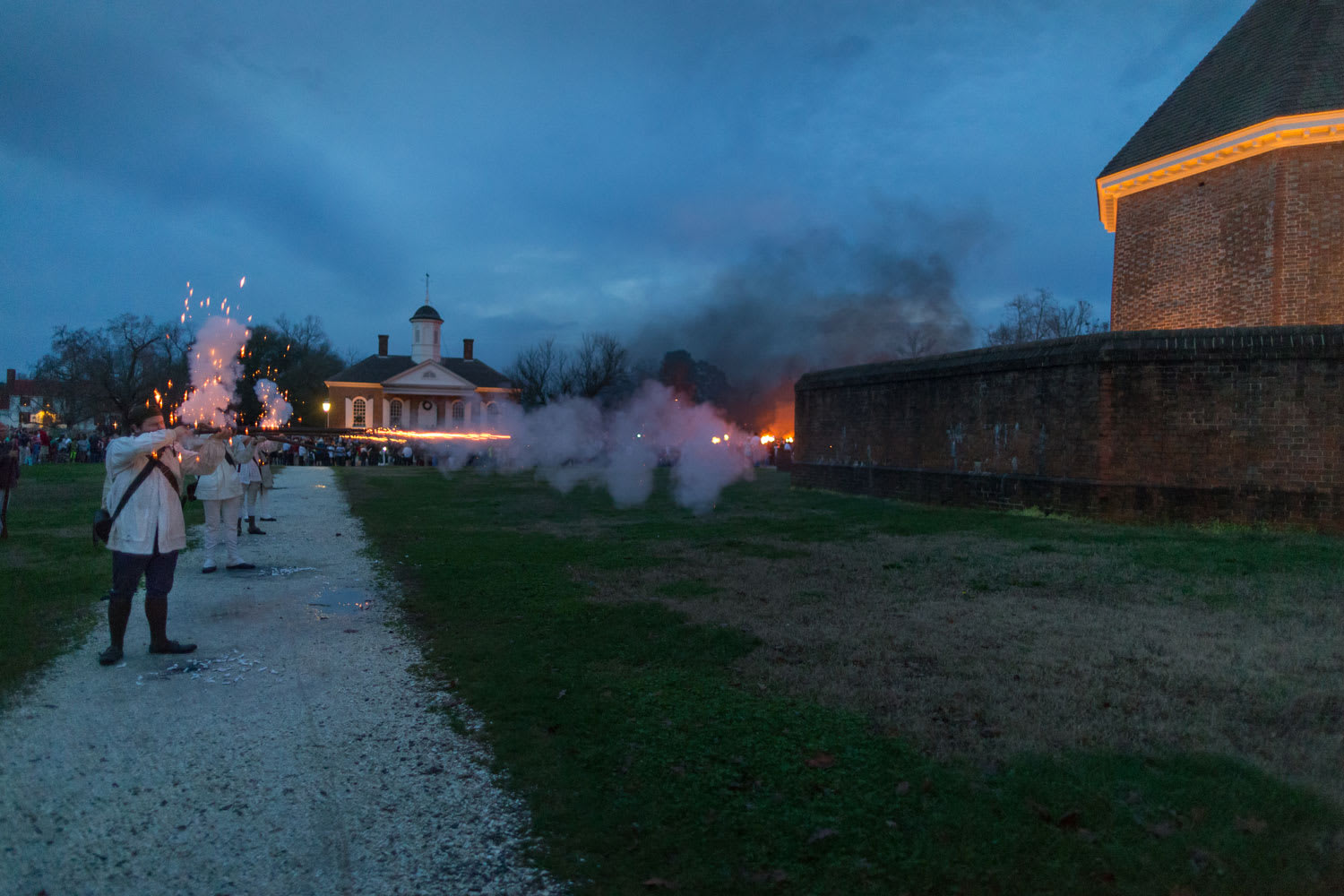
Colonial Williamsburg observes the holiday tradition of firing guns
on Christmas Eve 2015.
Myth 1: Christmas was quiet and peaceful.
“I was waked up this morning,” wrote Philip Fithian, a visitor in a Virginia plantation, “by Guns fired all round the House.” For Fithian, who may have been unfamiliar with the holiday tradition of firing guns at Christmas, this was a startling way for Christmas to begin. But men throughout the colonies made a habit of firing guns at Christmas, often to the chagrin of authorities who worried about the dangers.
Like the mornings, there were few silent nights at Christmas. The respectable folks sang carols, played games, performed plays, and danced to music. In places like Virginia, dancing in the summer could be unpleasantly hot, making Christmas a perfect time to plan a ball. Skilled Black musicians often performed for such occasions. One wealthy plantation family hired fiddlers, a jester, a tight-rope walker, and an acrobat for a Christmas celebration.
For those who couldn’t afford such extravagance, Christmas was often a time for excessive drinking. Depending on the household, people might consume brandy, rum, wine, gin, whiskey, beer, cider, cordials, or punch. One visitor to a Virginia gentry home recalled that there was “good wine and all kinds of beverages, so there was a good deal of carousing.” A New York newspaper complained about Christmas carousers disturbing “those citizens who would rather sleep than get drunk.”
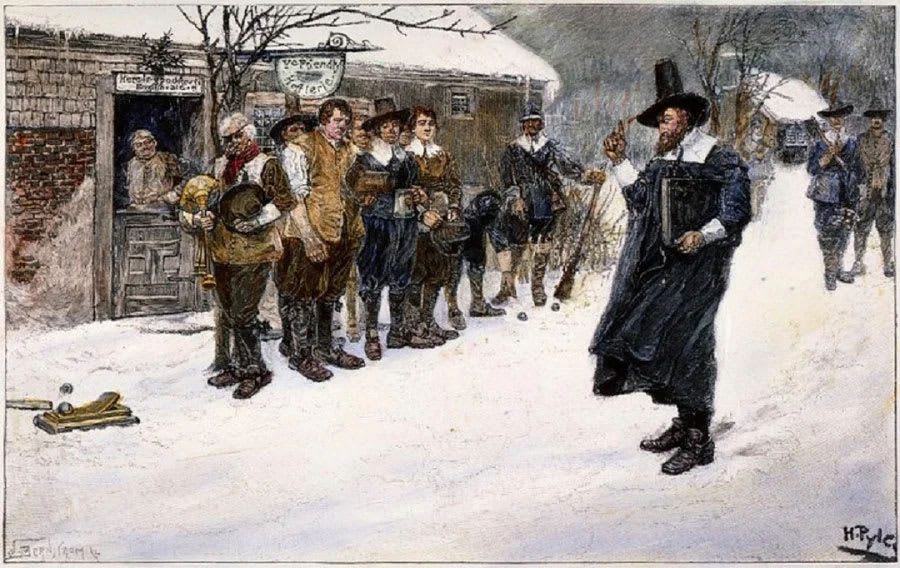
When Plymouth Governor William Bradford found some men playing games in the street on Christmas day, he took away their equipment and told them it was “against his conscience, that they should play, & others work.” Publications of the Colonial Society of Massachusetts (Boston: Colonial Society of Massachusetts, 2020), 93:213. Image: Howard Pyle, “The Puritan Governor interrupting the Christmas Sports” (1883).
Myth 2: Everyone celebrated Christmas.
American settlers disagreed about Christmas. Virginia’s eastern, Anglican communities like Williamsburg enjoyed celebrating the holiday. But it wasn’t an important event in many Scots-Irish, Presbyterian frontier communities. Philip Fithian saw both. Having been woken by gunfire at a Tidewater plantation, he was shocked to wake up in a Presbyterian community to silence. In his diary, he wrote, “Not a Gun is heard – Not a Shout – No company or Cabal assembled – To Day is like other Days.”
Other Protestant groups, including Quakers and Puritans, disliked Christmas. On Christmas 1795, Quaker Elizabeth Drinker wrote in her diary, “Called Christmass day: many attend religeously to this day, others spend it in riot and dissipation.” She noted that Quakers like her “make no more account of it than any other day.”
Many early Puritan New Englanders saw Christmas as an un-Biblical excuse for laziness and disorder. In 1659, the Massachusetts General Court made it a criminal offense to celebrate Christmas. But some colonists celebrated anyway. By the late eighteenth century, New Englanders widely celebrated Christmas, even as some of the clergy remained suspicious of it.
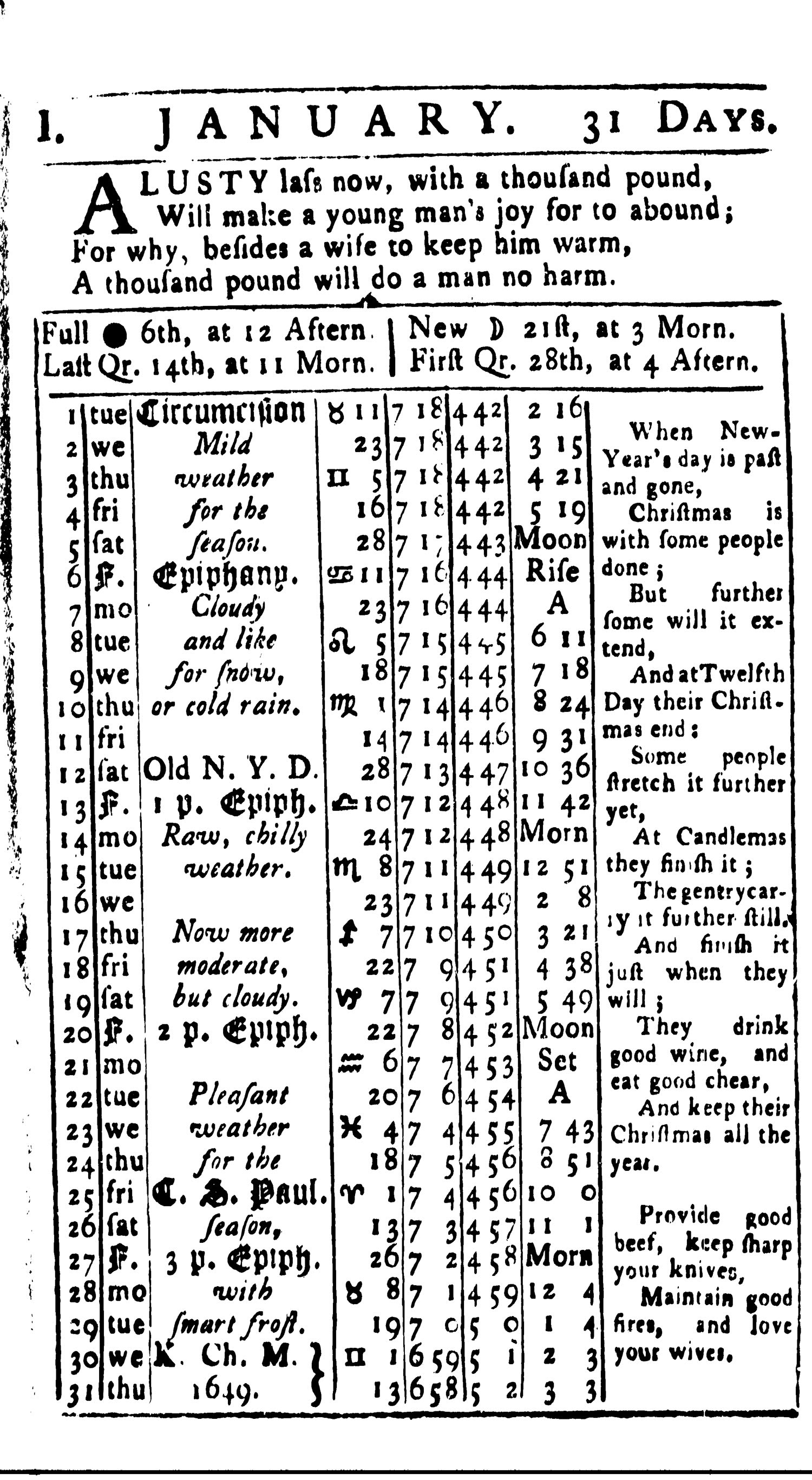
The 1765 Virginia almanack included a poem about Christmas on its page for January.
(Williamsburg: Joseph Royle, 1764)
Myth 3: Christmas was a single day.
When we start to hear Mariah Carey’s voice blaring from grocery store speakers in October, some of us wistfully imagine a time when Christmas was a day, rather than a season.
But in eighteenth-century America, Christmas took up a big chunk of the calendar. Virginia Anglicans celebrated from just before Christmas until Twelfth Night, on the evening of January 5. Some extended the season into February. A Virginia almanac for 1765 joked:
When New Year’s Day is past and gone,
Christmas is with some people done,
But further some will it extend,
And at Twelfth Day their Christmas end.
Some people stretch it further yet,
At Candlemas [Feb. 2] they finish it.
The gentry carry it further still
And finish it just when they will;
They drink good wine and eat good chear
And keep their Christmas all the Year. |
While the Christmas “season” now usually starts around Thanksgiving (or earlier) and ends shortly after December 25, an eighteenth-century Christmas season often began in mid-December and might carry on through January or early February.
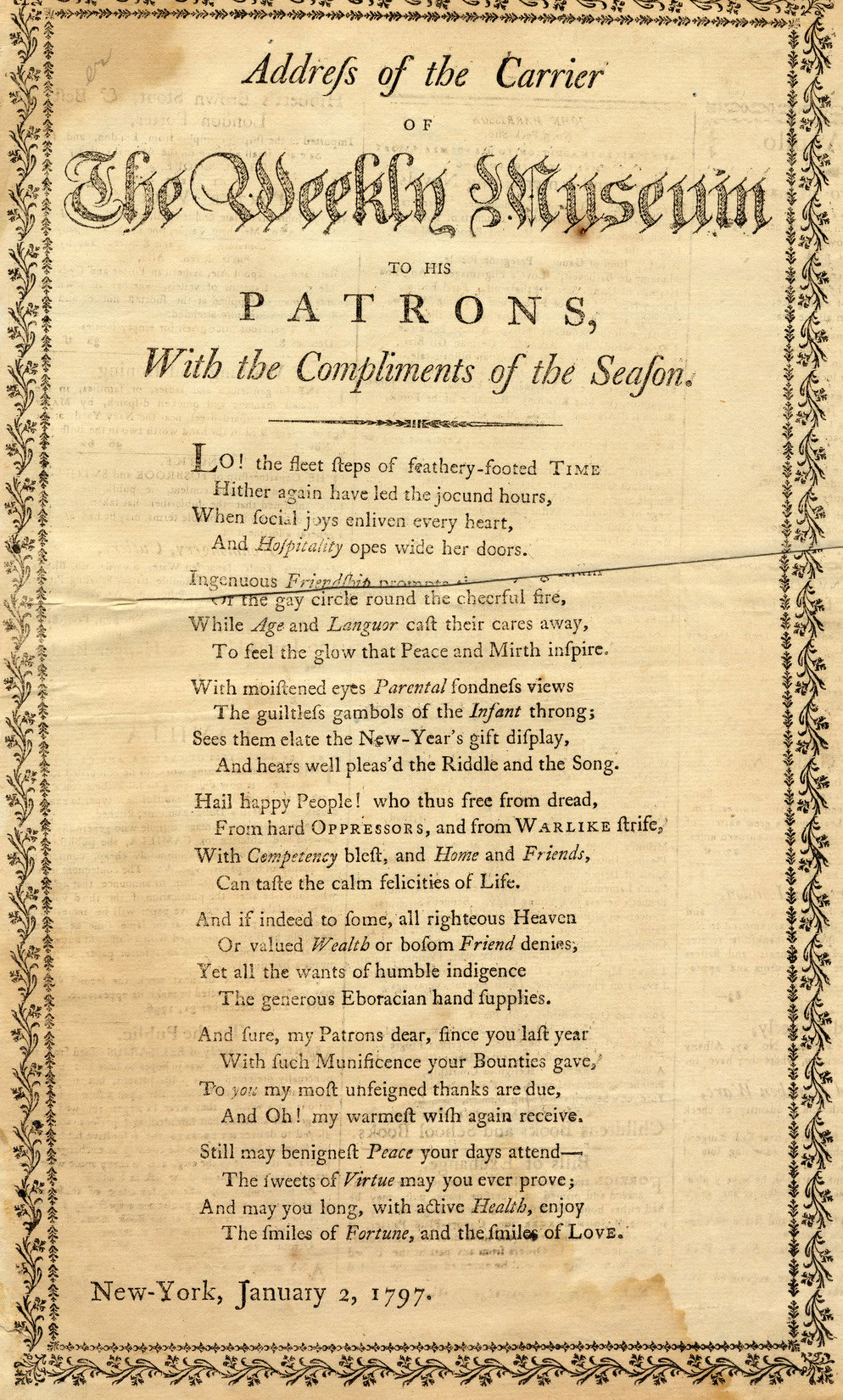
Newspaper carriers in early America presented poetic addresses around
Christmas or New Year’s Day to ask for tips.
“Address of the carrier of the Weekly museum to his patrons” (New York: 1797).
Brown Digital Repository, Brown University Library.
Myth 4: Christmas wasn’t always so materialistic.
Those who dislike the consumerism of modern Christmas celebrations might imagine that colonial Christmases were less materialistic than they are today. It’s true that family gift-giving wasn’t an essential part of the holiday prior to the nineteenth century. But for many people, Christmas was an important chance to receive money.
During the holiday, custom dictated that servants, apprentices, and enslaved people accepted tips from those whom they served. Sometimes these were called “Christmas-box” tips, for the container that traditionally stored the coins. Fithian recalled spending much of his Christmas morning at a Virginia plantation tipping the enslaved people.
Peter Fleet, who was enslaved by a Boston newspaper printer, delivered the Boston Evening-Post to subscribers. He accrued a small fortune in Christmas tips from his customers. In 1743, he wrote a will dispersing his funds to his son and the other children in the household. Anticipating that his enslavers might think he “got this money by Rogu[e]ry,” he explained that he “got it honestly; by being faithful to people ever since I undertook to carry the Newspapers, Christmas-days.” For many apprentices and enslaved people, Christmas was the most important time of the year to receive tips.
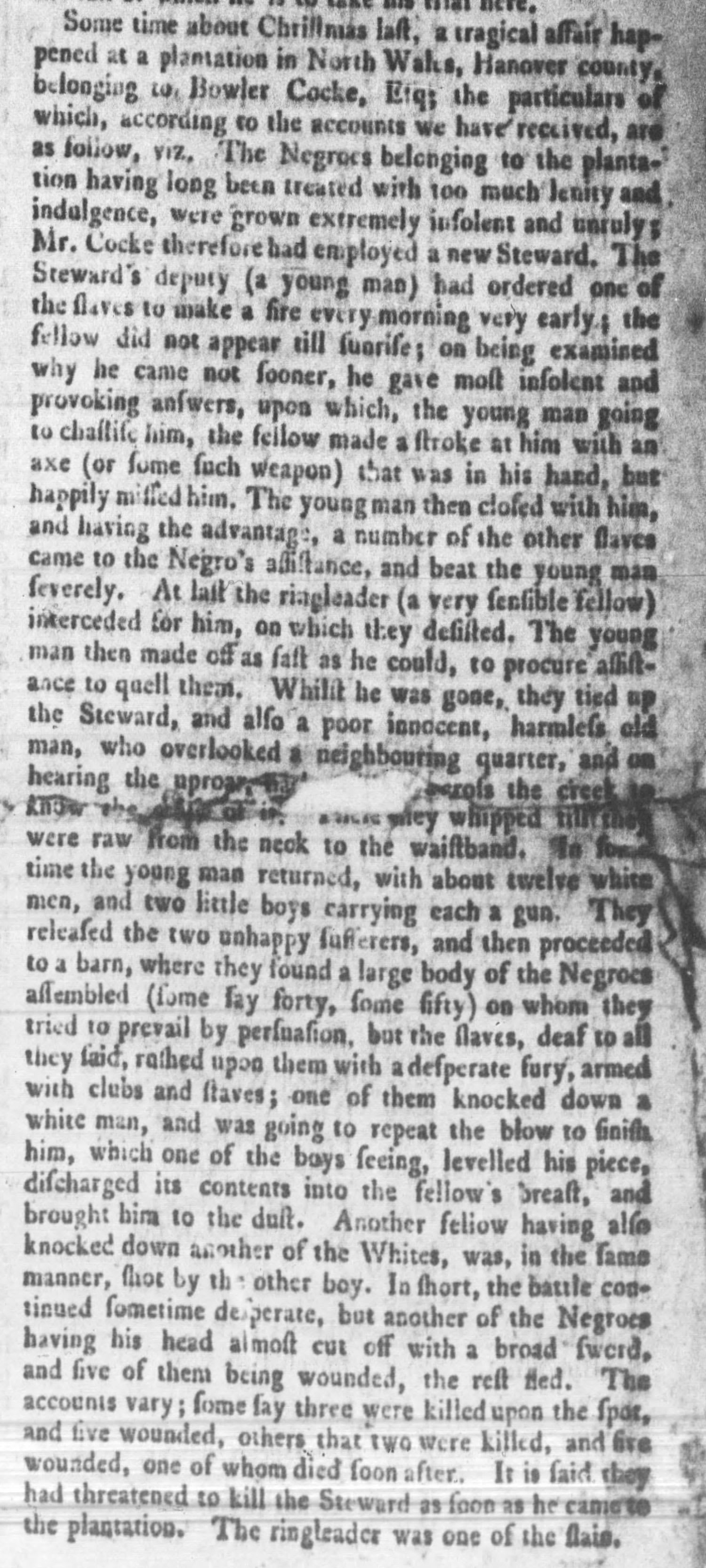
In early 1770, the Virginia Gazette published an account of a deadly Christmastime rebellion
of enslaved people at a plantation in Hanover County.
Williamsburg heading, Virginia Gazette (Rind), Jan. 25, 1770.
Myth 5: Enslaved people were happiest at Christmastime.
In the nineteenth century, enslavers often described Christmas as a moment of peace and paternal benevolence. It was a way they defended slavery. It was not universally true, yet an image of enslaved people having the chance to celebrate the holiday has persisted.
Christmas could be a tense time in a slave society. While some enslavers provided enslaved people with extra rations and time off during Christmas, many also feared that idle time would breed resistance. Colonial Virginia and South Carolina authorized Christmas slave patrols. Indeed, some enslaved people took advantage of unsupervised time at the holiday by emancipating themselves or fighting back against enslavers.
Some enslaved people received no respite at Christmas. The holiday might mean more work, not less, for someone serving meals or attending to guests. And some enslavers refused to offer any Christmas privileges. In 1774, Virginia enslaver Landon Carter congratulated himself in his diary for “not letting my [enslaved] People keep any part of Christmas.”
We have little first-hand testimony about the activities of those enslaved people who were allowed to celebrate Christmas. Like many others in early America, they probably observed the holiday with a mix of social events, leisure activities, and religious observances. One Presbyterian minister described a group of enslaved people in Virginia celebrating Christmas by “singing Psalms and Hymns in the evening, and again in the morning, long before the break of day.”

A Christmas wreath in the Colonial Williamsburg Historic Area from 2002.
Myth 6: Lavish Christmas decorations adorned homes.
In the 1930s, Colonial Williamsburg introduced holiday decorations in the Historic Area based on decorative elements available in the eighteenth century. Candles adorned windows. Festive wreaths with fruits like apples and pineapples hung on doors.
But there is no evidence that wreaths or candles decorated colonial homes at Christmas. In eighteenth-century Virginia, candles and fruit were precious commodities, especially during winter. Today, Colonial Williamsburg continues this cheerful decorative tradition each winter, even if it is a bit extravagant by eighteenth-century standards.
Though lacking exterior decorations, some eighteenth-century homes and churches decorated their interiors with evergreen tree branches at Christmas. Mistletoe, with the accompanying kissing ritual, was common as well.
Myth 7: Christmas happened at home with family.
Christmas was a major social event in many communities, rather than something celebrated only within a family. Dancing, food, music, and games drew households together. Where snow wasn’t expected, people planned trips for Christmastime. It was also a popular time of year for weddings.
During Christmas, according to one observer, “a universal Hospitality reigned” in Virginia: “Strangers are fought after with Greediness, as they pass the Country, to be invited.” One Virginia almanac shared these verses:
Christmas is come, hang on the pot,
Let spits turn round and ovens be hot
Beef, pork, and poultry now provide
To feast thy neighbours at this tide. |
It wasn’t until the middle of the nineteenth century that family celebrations at home became an indispensable part of Christmas.
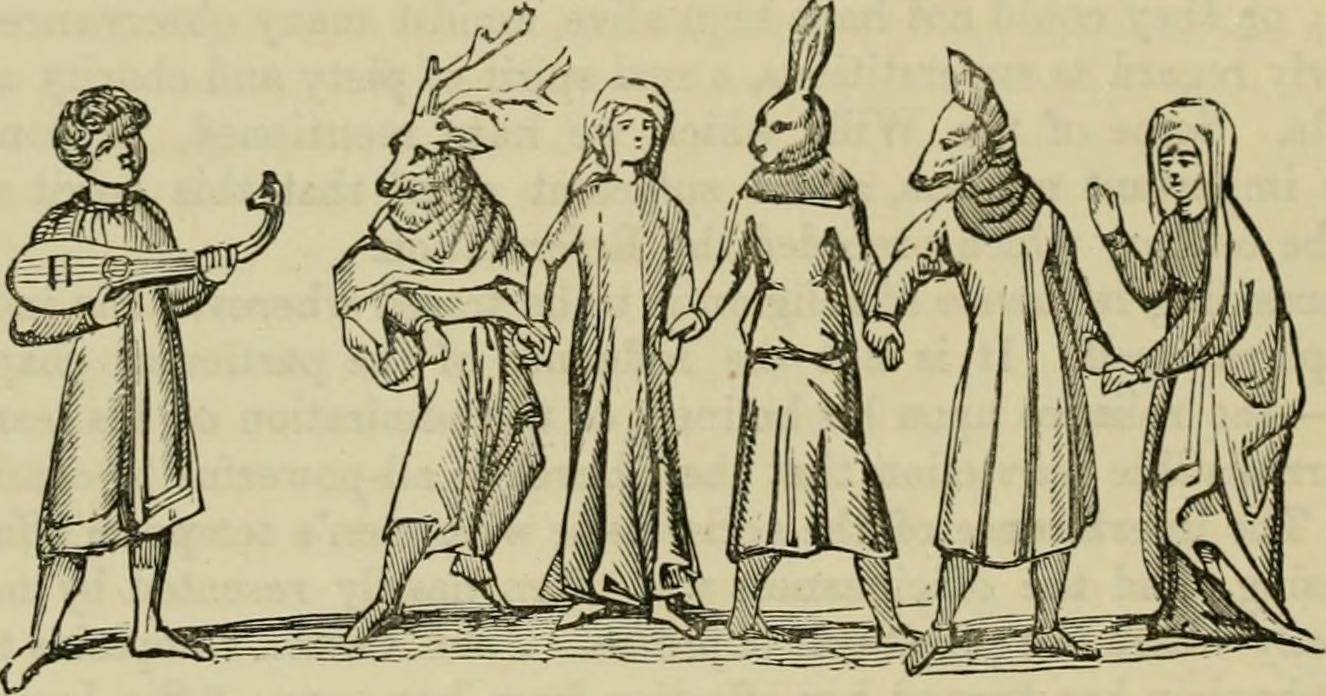
English mummers.
Old England: A Pictorial Museum, vol. 1 (London: Charles Knight, 1845), 308.
Myth 8: Christmas wasn’t political.
Today, Christmas often gets caught up in political and cultural arguments. But that’s not new. People in the eighteenth century sometimes took advantage of the Christmas season to challenge their social superiors. Drawing on European folk traditions, Christmas was a time when people shook things up and turned the social order upside down.
Students sometimes demanded a longer Christmas break by “barring out” their schoolmaster to prevent him from entering the schoolhouse. At William & Mary around the Christmas of 1702, the students launched a rebellion that the College’s President James Blair recounted: “I heard the School boys about 12 o’clock, a driving of great nails, to fasten & barricade the doors of the Grammar School.” He tried to force the doors open before the students “fired off 3 or 4 Pistols & hurt one of my servants.”
A rowdy gang of Christmas revelers called the “Anticks” menaced high-society Boston in the late eighteenth century. They engaged in an aggressive form of the English tradition of mumming, in which people performed short Christmas plays in exchange for food and drink. The Anticks would invite themselves into the homes of Boston’s wealthiest families and “demean themselves with great insolence.” When they concluded their disrespectful performance, they wouldn’t take the traditional gift of food and drink. They demanded cash. At any other time of the year, they might have been jailed for robbery and home invasion. But at Christmas, some Americans suspended their expectations about respect for social superiors.
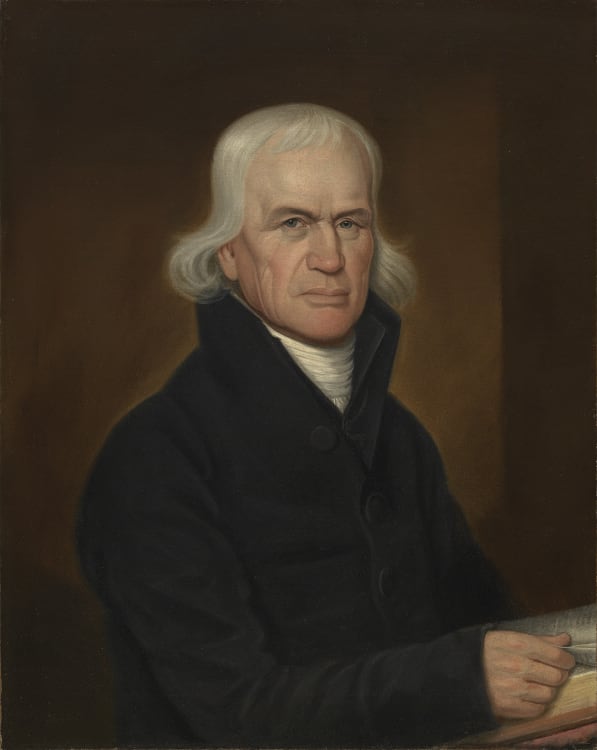
Methodist leader Francis Asbury once wrote, “Christmas day is the worst in the whole year
on which to preach Christ.”
Francis Asbury, The Journal of the Rev. Francis Asbury (New York: N. Bangs and T. Mason, 1821), 186.
Portrait in National Portrait Gallery
Myth 9: Christmas was a religious holiday celebrated in church.
Christmas brought many people in early North America into church. But not all of them. Some religious sects didn’t recognize Christmas. And in many places, church was not easily accessible. One London merchant stuck in Virginia for the holiday complained in his diary about being unable to find a “public place of worship” for Christmas services. There was a nearby church, he noted, but “there happens to be no preacher. Being Christmas Day you miss it more than common.”
Even in places where Christmas was celebrated by a religious leader, attendance might be sparse. As one newspaper described, it was “the temples dedicated to the service of merriment, dissipation and folly” that were crowded, rather than the churches.
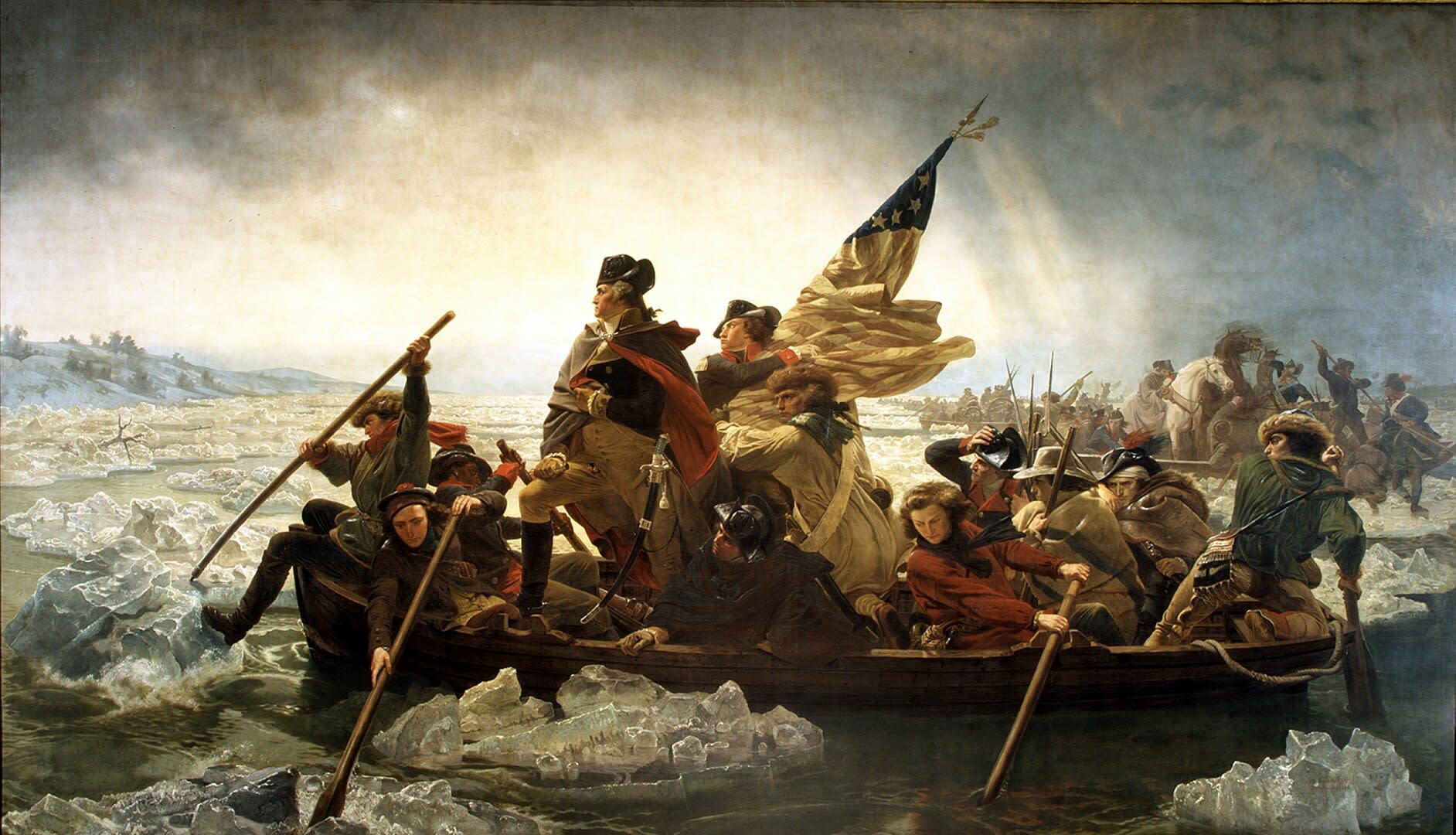
Emanuel Leutze, Washington Crossing the Delaware (1851).
Metropolitan Museum of Art.
Myth 10: George Washington defeated Hessian mercenaries who had been drinking to celebrate Christmas.
In the early morning of December 26, 1776, General George Washington led the Continental Army to a major victory by attacking an encampment of Hessian mercenaries at Trenton. It’s often said that these Hessian soldiers were unable to organize their defenses because they were all drunk or hung over from Christmas celebrations. It’s a good story.
But there is no evidence that the Hessians were drunk. One American soldier present that night testified in 1809 that “I did not see even a solitary drunken soldier belonging to the enemy.” If the Hessian troops fought poorly, it may have been because they were exhausted from a week of fighting.

During the nineteenth century, Americans celebrated the sentimental joy of children during Christmas.
This would have been unusual in the previous century.
The Stranger’s Gift: A Christmas and New Year’s Present, ed. Hermann Bokum
(Boston: Light and Horton, 1836).
Myth 11: Christmas has always been a magical time for children.
Christmas wasn’t very much fun for eighteenth-century children. Some wealthy children received gifts, such as books or candy. But most accounts of early Christmas celebrations don’t mention children. Many of the most widely embraced Christmas traditions—gambling, excessive drinking, shooting guns, fox hunting—were not very child friendly. Children might be allowed to participate in some adult activities, like dancing and going to church. But they had to wait until the nineteenth century for Christmas celebrations to become oriented around them.
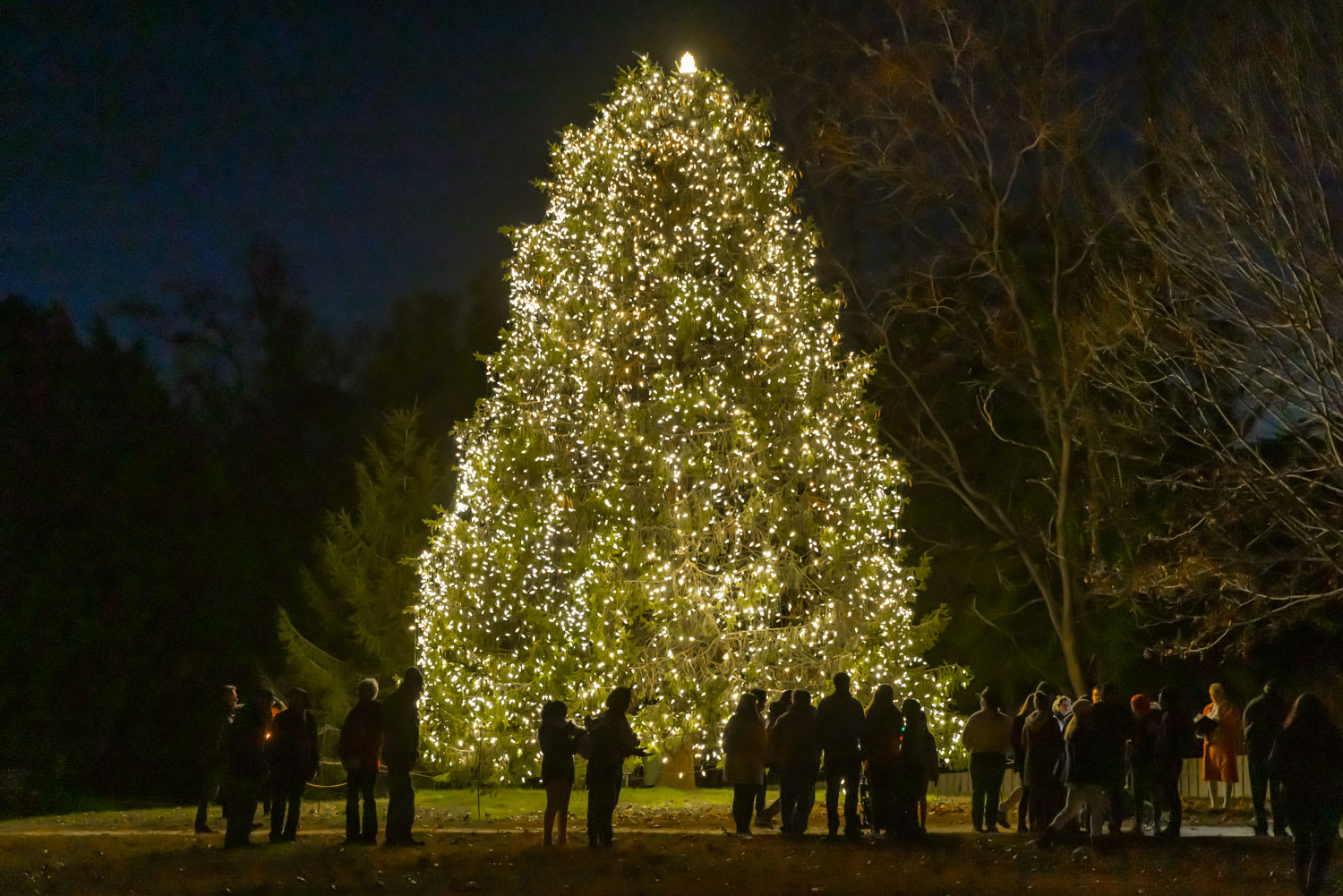
A view from the Colonial Williamsburg Community Tree Lighting Ceremony
held near the Courthouse on December 1, 2022.
Myth 12: Eighteenth-century Americans celebrated Christmas with Santa Claus and Christmas trees.
For many Americans today, it wouldn’t be Christmas without a decorative tree and a jolly man in a red suit. But these things were unknown in eighteenth-century North America.
Christmas trees first appeared in medieval Germany. And Protestant cultures in northern Europe replaced the Catholic Saint Nicholas (whose feast was celebrated in early December with gifts) with Santa-like folk characters such as Belsnickel and Sinterklaas. Some have suggested that early Dutch and German immigrants brought these practices into colonial North America. But there’s no documentation of Santa Claus or Christmas trees in North America until the early nineteenth century.
A German refugee named Charles Minnigerode introduced the first documented Christmas tree in Virginia in 1842. He had settled in Williamsburg as a professor at William & Mary and befriended the family of Nathaniel Beverly Tucker. At Christmas, he delighted the Tucker children by sharing the German custom. He hacked off the top of an evergreen, brought it inside, and helped the children decorate it. Soon, neighboring children heard about the tree and came to see it at what is now the St. George Tucker House. Many decades later Martha Page Vandegrift, who saw the tree as a child, recalled,
He set up an evergreen in the sitting room and decorated it with candles and bits of bright paper and way at the top of the branches he hung a gilded star. We children danced and shouted for joy when those candles were lit one by one. We’d never seen anything in the world so beautiful! I’ve never had a merrier Christmas than that one—never, ever—and I’ve had ninety-five of ‘em.
6 Scary Christmas Legends
By Noel Kirkpatrick
CHRISTMAS ISN'T ALL JINGLE BELLS AND JOLLY OLD ST. NICK. There are darker and creepier figures lurking about, and they don't come from the North Pole.
Many of these scary figures hail from pre-Christian traditions and folklore and have become enveloped in Christmas over time. Where Santa is about rewarding well-behaved children, some of these entities are focused on the naughty list. If threatening your kids about Santa won't get them to behave, perhaps a story about an ogre coming to cook them in a stew will.
Of course, not all these horrific holiday figures are evil. Some are more mischievous and benevolent, despite their more-appropriate-for-Halloween appearances. Still, if your kid cries upon meeting Santa, maybe don't tell them about the Krampus.
Belsnickel
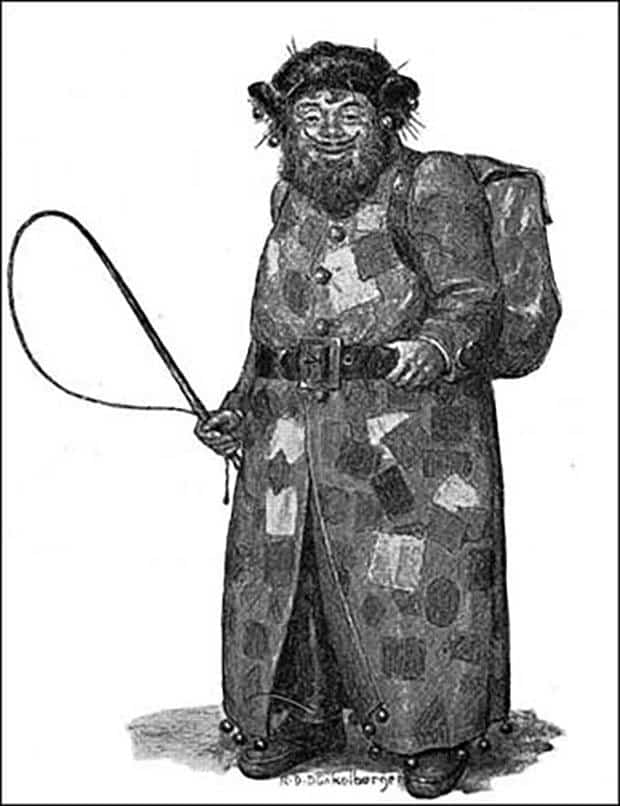
Belsnickel as portrayed in folklore
"Bels" roughly translates as "fur" in German and nickel here refers to jolly old St. Nikolas, so Belsnickel is St. Nick in furs or pelts. And this figure from German folklore does indeed dole out the occasional gift like Santa Claus. He even carries a sack filled with candy and nuts for good little children. That, however, is where the similarities end. Instead of a nice coat, Belsnickel's furs are grimy, or sometimes just outright dirty. And while St. Nick will just leave a lump of coal for naughty children, Belsnickel will whip them on their backs with a switch.
La Befana
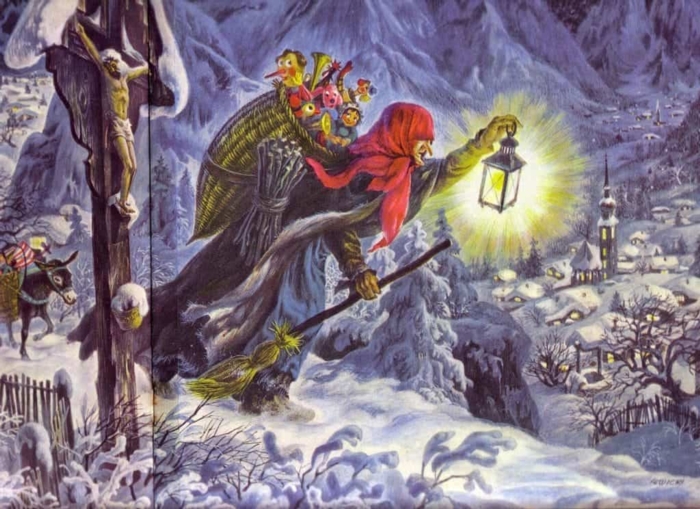
La Befana may be scary-looking, but she's a benevolent figure.
Just because someone is scary-looking doesn't mean they always are. La Befana may look like a hag, but this Italian witch is not a creature of Halloween. She is actually associated with the Epiphany, a post-Christmas observance that celebrates the arrival of the three wise men in Bethlehem. Legend has it that the Befana was asked by the wise men to join them, but she declined as she had too much work to do. Realizing her mistake, she tried to catch up to them, but she was unable to do so. Exhausted on the eve of their arrival in Bethlehem, she threw herself under a tree and a branch from that tree became a magical broomstick that allowed her to fly, looking for the baby Jesus. Today, the Befana appears during and just before Epiphany events, giving treats and small gifts to good children, or leaving the gifts at their houses, much like Santa Claus.
Grýla
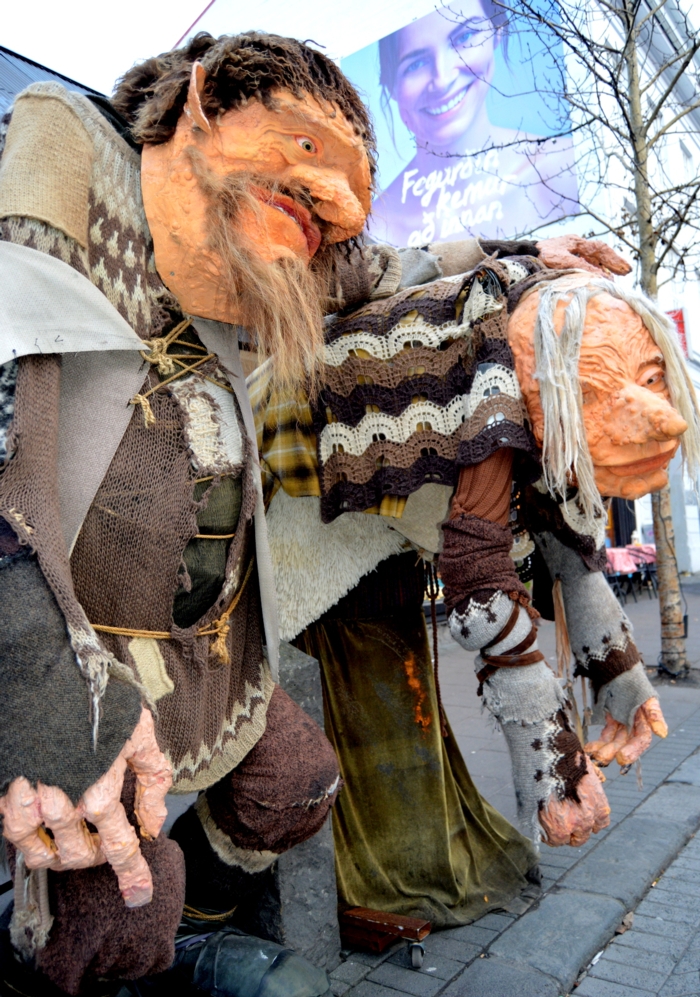
Grýla (right) and her husband Leppalúði
Of course, not all witches that appear at this time of year are good witches. Grýla hails from Icelandic folklore and is more interested in eating children than giving them things to eat. Come Christmas time, Grýla is said to come down from her mountain and seek out naughty children. She gathers them up in a sack and carries them back to her mountain in order to make them into a stew. While the Befana is often a kind-looking witch, Gryhla is truly a hideous-looking one, with horns on her head, many tails, and a very large, wart-covered nose. This is one Christmastime visitor you don't want to see.
Krampus
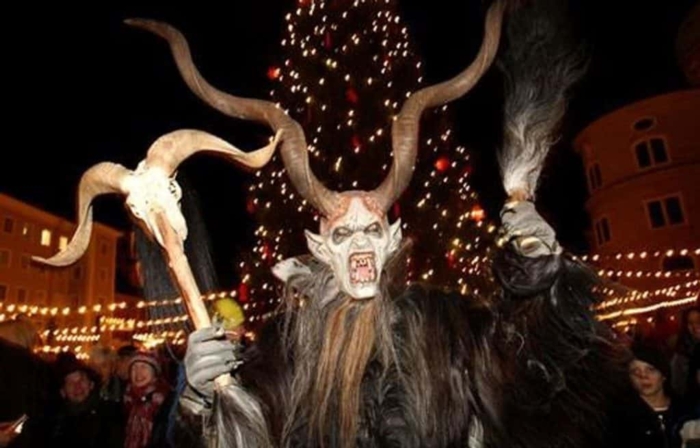
The Krampus is coming to town.
Perhaps the best known of scary Christmas figures is the Krampus. This creature hails from central European traditions. Though the exact origins are muddled, scholars agree Krampus dates back to a pre-Christian time. The name derives from the German word "krampen," which means "claw." An appropriate name given that Krampus is often a demonic-looking figure with claws, horns and a very long tongue. Like Grýla, the Krampus hauls off naughty children in a sack to use later as food.
People celebrate Krampus with festivals before Christmas, dressing up as scary figures as a way to balance the now very sweet traditions of Christmas. Though the festivals can occur through the month, they often begin on Krampus Night or Krampusnacht, which is in some European countries is the night before the Feast of St. Nicholas on Dec. 6. "The Krampus is the yin to St. Nick's yang," Jeremy Seghers, organizer of the first Krampusnacht festival in Orlando, Florida, told Smithsonian Magazine in 2015. "You have the saint, you have the devil. It taps into a subconscious macabre desire that a lot of people have that is the opposite of the saccharine Christmas a lot of us grew up with."
Yule Cat
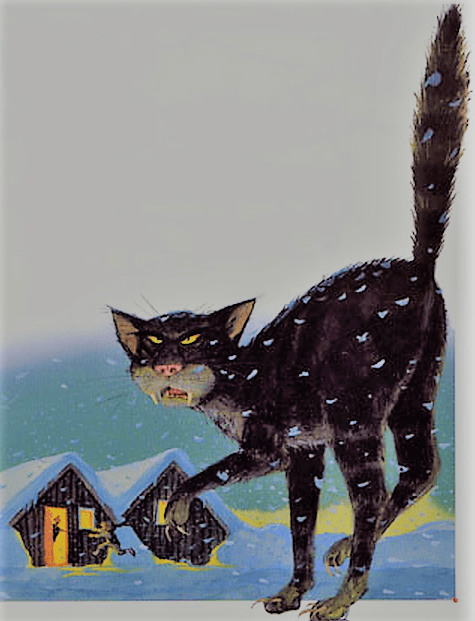
You'd better hope there are tacky Christmas sweaters in those boxes.
Known as the jólakötturinn in its native Iceland, the yule cat is a very fashion-conscious Christmas monster. This not-so-festive feline towers over houses, peeking in to see if children have gotten new clothes since last Christmas or for the holiday this year. If they did, it was safe and the cat would move on to the next house. If not, the child would be gobbled up (provided Grýla didn't get there first, we suppose). So the next time you're bummed about getting socks for Christmas, just think that they helped to protect you from the yule cat.
Mari Lwyd
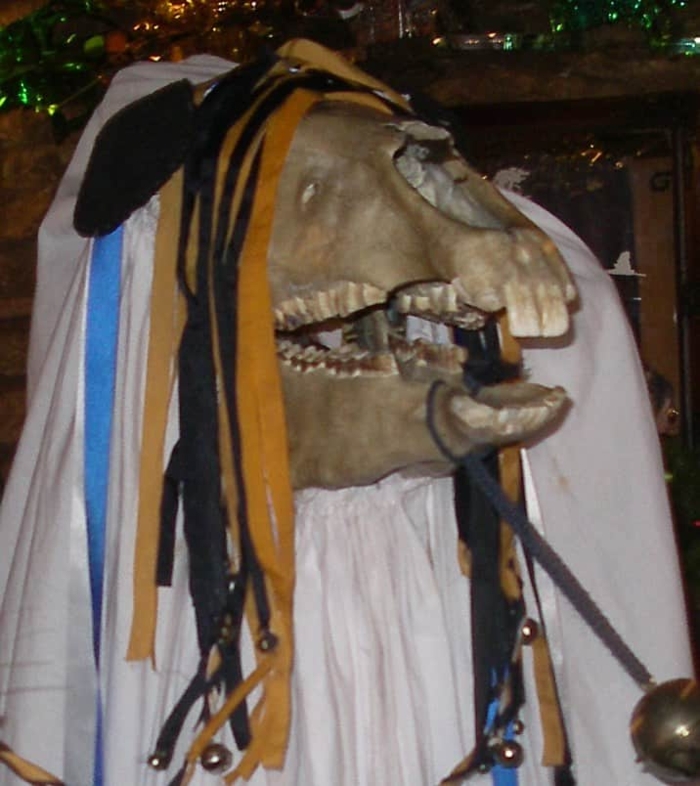
Sure, scary horse-headed spirit, I'll sing you a song.
As if you weren't scared enough, here comes a Welsh skeletal horse spirit. Mari Lwyd, or Y Fari Lwyd in Welsh, is a custom in which revelers will visit your home while carrying a horse skull that's been decked during the holidays with ribbon, bells, and a sheet to give the whole affair a ghostly appearance. The Mari Lwyd troupe will engage the owner in a battle of verses and insults. If the troupe has the cleverest rhymes, they're allowed in for drinks and food while Mari Lwyd will scare away anything unwanted from the year. (Even if the owner wins the verse battle, they still let in the troupe for this reason.) Like many of the creatures on the list, Mari Lwyd's origins are lost, though there's a long history of white horses in British folklore, with horses themselves representing power and fertility.
Treehugger: Kirkpatrick, Noel. "6 Scary Christmas Legends."
https://www.treehugger.com/scary-christmas-legends-around-world-4863575#:~:text=%206%20Scary%20Christmas%20Legends%20%201%20Belsnickel.,of%20Akureyri%2C%20Iceland.%20%20...%20Of...%20More%20
Myth or Truth? --Part 2
MYTH: Clement C. Moore Wrote "Twas the Night Before Christmas."
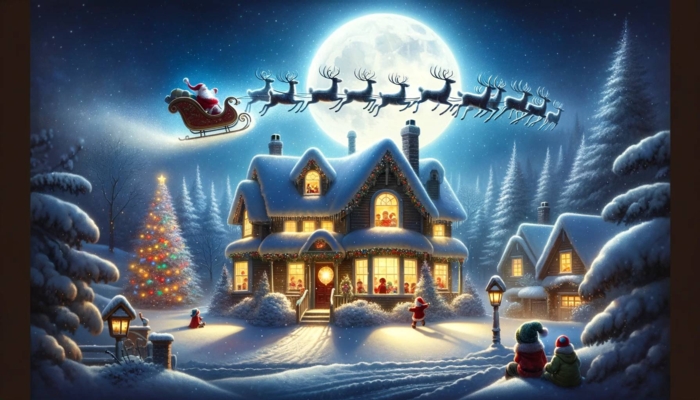
TRUTH: How many of us snuggle with family members every Christmas season to read "A Visit from St. Nicholas," aka "'Twas the Night Before Christmas"? This poem has been popular since it was first published in New York's Troy Sentinel on Dec. 23, 1823.
The poem was published anonymously, and it wasn't until 1836 that someone stepped forward as the author: Clement Clarke Moore, a professor and poet. According to Moore, he wrote the poem for his kids; and later, unbeknownst to him, his housekeeper sent it to the newspaper. But once Moore claimed to be the author, members of the Henry Livingston, Jr. family cried foul, saying their dad had been reciting the very same poem to them a full 15 years before it was published. Livingston, interestingly, was a distant relative of Moore's wife.
Who was telling the truth? At least four of Livingston's kids, and one neighbor, said they remembered him reciting the poem as early as 1807. He was also part Dutch, and many references in the poem are, too. Plus scholars who studied Moore's other written works say they're all vastly different in structure and content from "A Visit from St. Nicholas." But Moore did claim authorship first. He was also friends with Washington Irving, who knew all about Dutch culture and had previously written about St. Nicholas. Add all these clues together, and the question of the famous poem's authorship is still up in the air.

MYTH: Decorations Should Come Down on January 6.
TRUTH: Until the 19th century, people would keep the decorations of holly, ivy, box, yew, laurel, and mistletoe up until February 2, Candlemas Day, the end of the Christmas season, 40 days after the birth of Jesus.
In the reign of Victoria, decorations came down on Twelfth Night, January 6, and generally were burned. The general consensus in the UK seems to have January 5 as Twelfth Night although other Christian groups believe January 6 is correct because it is the 12th day after Christmas, the length of time Christians traditionally celebrated the birth of Jesus.
Taking down decorations a day earlier or later was considered unlucky, and it was thought that if they were left up after Twelfth Night, they should remain in place for the whole year. People believed that tree spirits lived in festive decorations; and while you look after them during Christmas, if you don’t release them afterwards, this could have consequences for the rest of the year. They believed that vegetation would not grow and there would be agricultural problems and food shortages.
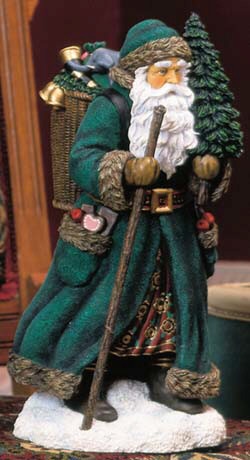 |
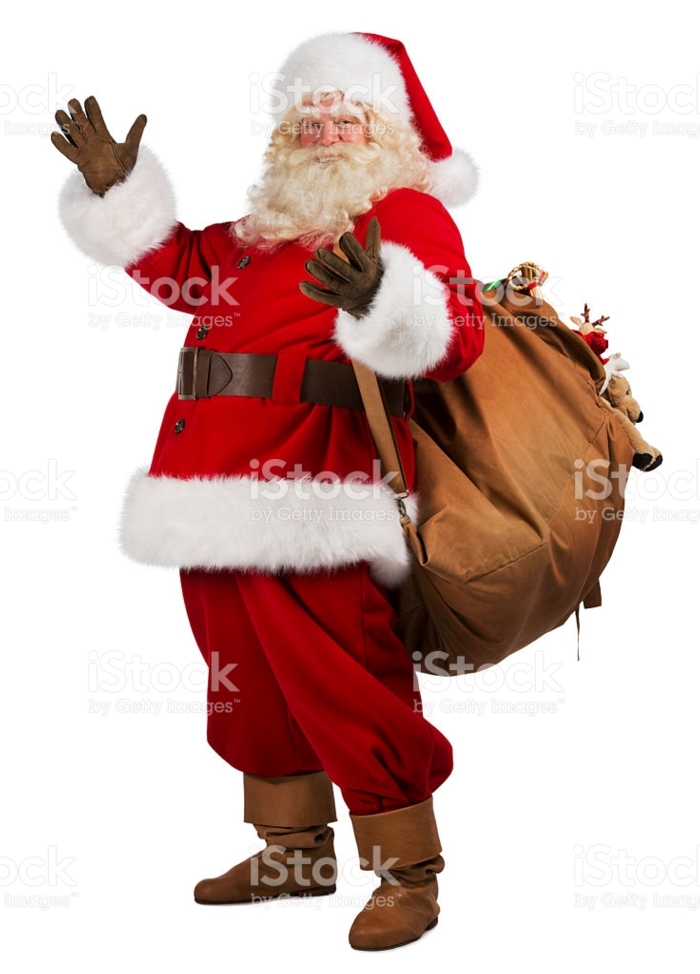 |
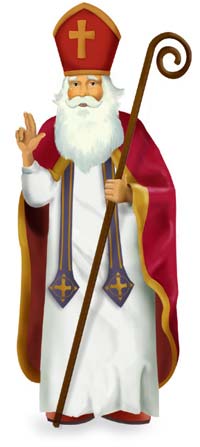 |
| Father Christmas |
Santa Claus |
St. Nicholas |
|
MYTH: Santa Claus, St. Nicholas, and Father Christmas Are All the Same.
TRUTH: This is a tricky one. The three are definitely different, yet they sometimes can be considered the same person. St. Nicholas was a fourth-century Turkish bishop who spent his life giving money to the poor, and it's said one of his favorite methods was secretly leaving money in people's stockings overnight. Nicholas died on December 6 and was eventually proclaimed a saint. Thus, December 6 became known as St. Nicholas Day. Various cultures celebrated by instructing their kids to leave out stockings or shoes the night before so "St. Nick" could fill them with gifts like fruit, nuts, and candy.
By the 16th century, Europeans were turning away from the idea of St. Nicholas, but they loved the gifting tradition. So St. Nick morphed into a guy named "Father Christmas." First mentioned in 15th-century writings, he was a partying man associated with drunkenness and holiday merrymaking. In the U.S., St. Nick became Kris Kringle. Father Christmas and Kris Kringle generally brought gifts on Christmas, not Dec. 6. When Dutch settlers began emigrating to the U.S., they brought with them stories of St. Nicholas, whom they called Sinterklaas. Soon Sinterklaas became Americanized as Santa Claus.
By the 20th century or so, all of the Father Christmases, Kris Kringles, etc. became "Santa Claus," uniformly depicted as a round-bellied, white-bearded old guy who brings gifts on Christmas Eve or Christmas Day. Yet some people around the world, namely Christians from European countries where St. Nick was a beloved hero, still celebrate St. Nicholas Day on Dec. 6 by setting out shoes or hanging stockings the night before. So while Father Christmas and Santa Claus are definitely now one and the same, St. Nicholas is still a toss-up, with some people recognizing him as a distinct individual and others lumping him in with the other gift-bearing men.

MYTH: Boxing Day is for Boxing Up Gifts for Return.
TRUTH: Lots of people have never heard of Boxing Day. Those who have -- and who know it falls after Christmas -- often think it's a day designated for boxing up any gifts you don't want, don't like, or can't use, and taking them back to the store. Nice as that may sound to anyone who's used to receiving bum gifts, unfortunately it's completely wrong.
Boxing Day is December 26, and it's a celebration that takes place only in a few countries. It started in the United Kingdom during the Middle Ages as the one day of the year when churches opened their alms boxes, or collection boxes, and doled out the money to the poor. Servants were also given this day off to celebrate Christmas with their families, having had to work for their bosses on Christmas Day.
The holiday changed over time. In the years leading up to World War II, blue collar workers such as milkmen, butchers, and newspaper boys used the day to run their routes and collect Christmas tips from clients. Today, in certain countries such as the United Kingdom, Canada, Australia, and New Zealand, Boxing Day is a day when certain sporting events are held, namely horse races and soccer matches. What that has to do with alms for the poor -- or boxes -- is another mystery.
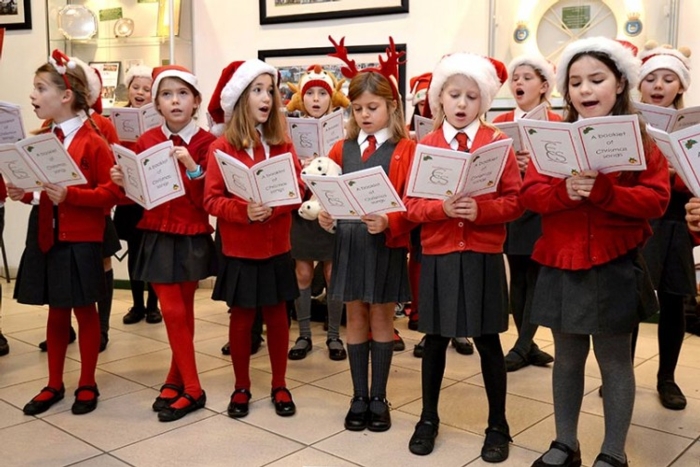
MYTH: U.S. Students Can't Sing Religious Carols in Public Schools.
TRUTH: This idea is false -- at least for now. As long as secular songs are included in a school holiday concert's repertoire, Christmas carols may also be sung. But there's much debate over whether singing any sacred choral music in public schools is a violation of the U.S. Constitution's Establishment Clause. The Constitution's First Amendment says "Congress shall make no law respecting an establishment of religion." This "Establishment Clause" is at the heart of many disputes over what people consider freedom of conscience, freedom of speech, and freedom of religion. As of now, however, there's been no ruling by the Supreme Court and no Constitutional amendment banning this practice. Some individual school districts, however, have banned Christmas music in school concerts.
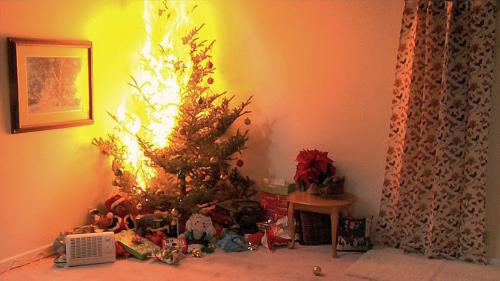
MYTH: Christmas Trees, Even Real Ones, Aren't That Likely to Catch on Fire.
TRUTH: We hear about the dangers of Christmas trees -- especially real ones -- bursting into flames every year at Yuletide. Yet neither real nor artificial Christmas trees are that likely to catch on fire. First, real trees simply don't spontaneously combust, even if you forget to water them. And secondly, actual cases of any Christmas trees causing residential fires are extremely rare. According to the National Fire Protection Association (NFPA), between 2005 and 2009 U.S. fire departments responded to an average of 240 home fires per year that began with Christmas trees. With tens of millions of trees both fake and real sold every year, 240 fires is a pretty small percentage. Of course, this doesn't mean you should take unnecessary risks. If you have a real tree, water it regularly and remember to turn off the lights when you're away. Remember, too, that overloaded outlets and faulty wires are the biggest potential culprits when it comes to holiday fires.
SOURCES:
________, "Traditions & Customs," https://www.whychristmas.com/
Mcmanus, M.R., “10 Myths About Christmas,” https://people.howstuffworks.com/culture-traditions/holidays-christmas/10-christmas-myths11.ht
Huckabee, T., “4 Christmas Myths We’ve All Totally Bought (And The Truth Behind Them," https://relevantmagazine.com/article/4-christmas-myths-weve-all-totally-bought/
Van Luling, T., “Everything You Know About Christmas Is Wrong," https://www.huffingtonpost.com/2013/12/09/christmas-history_n_4378951.html
Rothschild, M., “The Biggest Christmas Myths and Legends, Debunked," https://www.ranker.com/list/christmas-myths/mike-rothschild
Myth or Truth? --Part 1
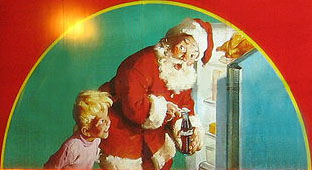
MYTH: Coca-Cola Designed the Modern Santa Claus as Part of an Advertising Campaign.
TRUTH: The characteristic depiction of Santa Claus developed close to his current form in the late 19th and early 20th centuries. In fact, most of his modern image was put together by cartoonist Thomas Nast in the 1870. Coca-Cola ran its famous advertising campaign in the 1930s -- well after Santa's image was created. The campaign did help to further popularize the character and the cola, but the company did not make his clothes red to correspond better with Coke. Santa had already been depicted with red clothes.
Furthermore, Coca-Cola wasn’t even the first soft drink to be marketed with Santa Claus. The company White Rock Beverages used images of Santa Claus wearing red to advertise mineral water in 1915.
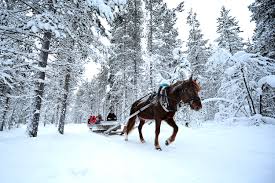
MYTH: Jingle Bells Is the Essence of Christmas.
TRUTH: Except it’s not. Jingle Bells was written by James Pierpont in 1857. Pierpont was American, and the song (originally called One Horse Open Sleigh) is about Thanksgiving and, more generally, about winter fun and frolics. How very “un-Christmassy” it is can be gleaned from the other verses, which never make it into a Christmas concert. Verse two through four go like this:
|
A day or two ago I tho’t I’d take a ride
And soon Miss Fannie Bright was seated by my side.
The horse was lean and lank, misfortune seemed his lot
He got into a drifted bank and we – we got upsot.
CHORUS
A day or two ago, the story I must tell
I went out on the snow and on my back I fell;
A gent was riding by, in a one-horse open sleigh,
He laughed as there I sprawling lie; but quickly drove away.
CHORUS
Now the ground is white; go it while you're young,
Take the girls tonight and sing this sleighing song;
Just get a bobtailed bay, two forty as his speed
Hitch him to an open sleigh and crack! You'll take the lead.
|
MYTH: You Don’t Kiss under Mistletoe To Be Romantic. You Do It So You Don’t Die.
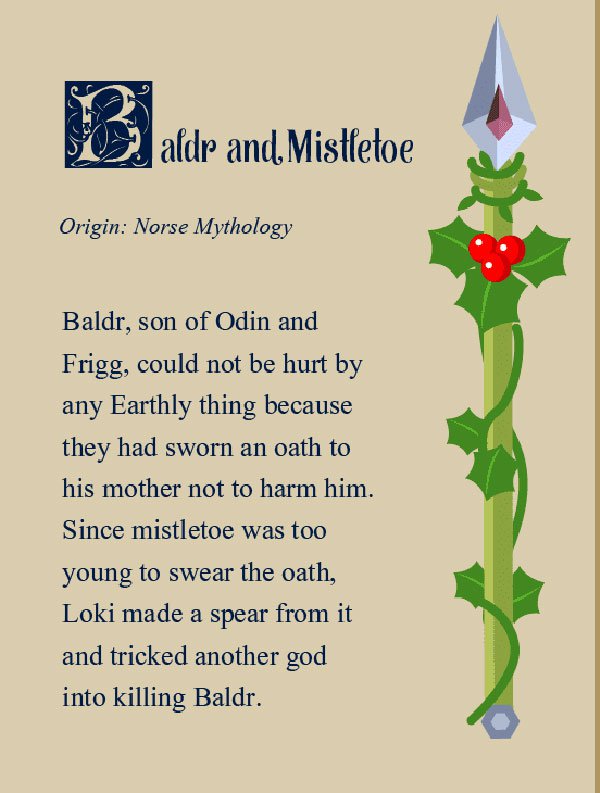
TRUTH: Baldur was the grandson of the Norse god Thor and lived in terror because he believed that every living plant and animal intended to kill him. Cowering in fear, he locked himself in his room. His wife and mother scoured the land and begged all the living things, except mistletoe, to be kind and to leave Baldur alone. They thought that asking mistletoe was pointless because it was so lowly.
When they returned to Baldur and announced all living things had promised not to harm him, Baldur felt free of his fears and challenged other gods to throw objects at him, believing they would simply bounce off of him. Mischievous Loki made an arrow, or spear, from the wood of mistletoe, threw it, and killed Baldur. As a result, we hang mistletoe above the door to never forget the tale and to remember the dangers of neglecting the “small things.”
If you’re still feeling romantic about mistletoe consider that the word comes from the Anglo-Saxon words, mistel (dung) and tan (twig). It is believed to be named after what branches look like after birds have "droppings.”
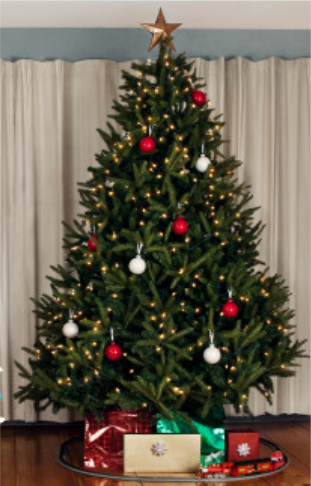
MYTH: Christmas trees are a relatively recent tradition in the United States.
TRUTH: In ancient times, evergreen plants were used for winter decoration to remind people that “life” would return in the Spring. This practice was often tied to worship, as the Egyptians did with Ra and the Romans did with their festival of Saturnalia. The translation of this tradition into the modern Christmas tree began in the 16th century when German Christians started placing decorated evergreens in their homes. (Some say it’s possible that the Protestant reformer, Martin Luther, was the first person to add lit candles to a tree – which later led to Christmas lights when electricity was invented.)
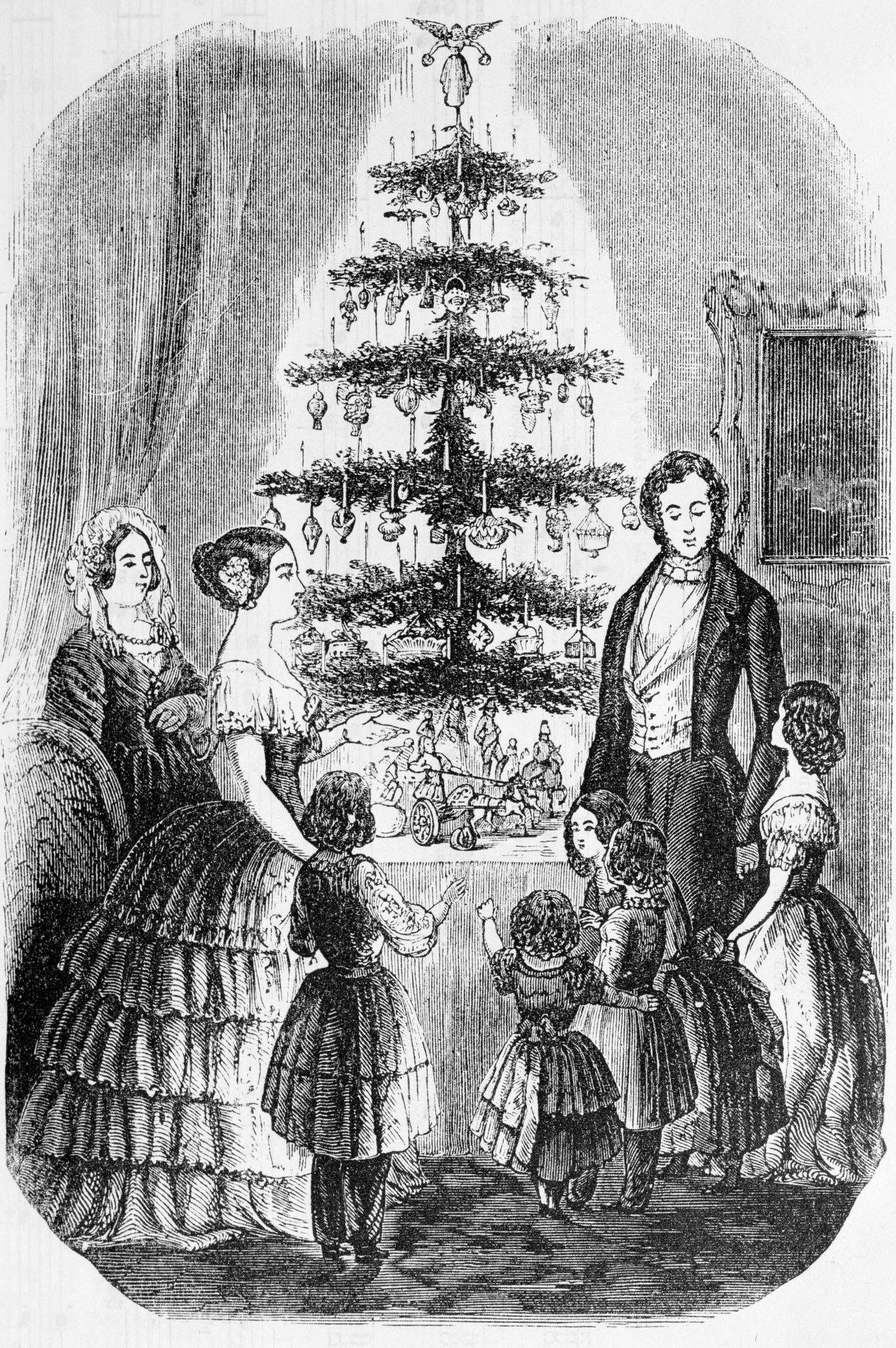
It did take a while for Americans to adopt the Christmas tree, however. Until around 1840, the trees were still seen here as pagan symbols. In 1846 a magazine spread was widely published that featured Queen Victoria and her family standing around a Christmas tree — her husband was German. The publication inspired the custom and use of decorated trees becoming popular in the U.S.
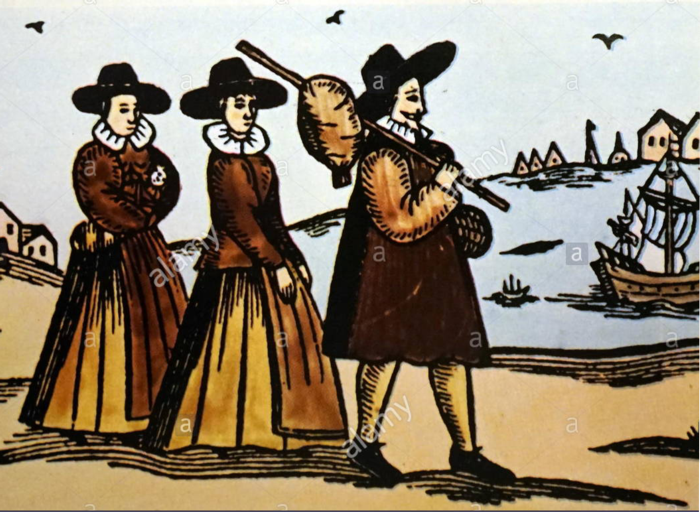
MYTH: Christmas was actually banned in America for a time.
TRUTH: Early Puritanical America actually outlawed Christmas from 1659 to 1681 in Boston, although New York and Virginia still celebrated the holiday. After the American Revolution, the holiday went completely out of vogue, as it was seen as a British custom and even the non-Puritanical Americans wanted nothing to do with it.
Christmas started to come back into favor slowly and eventually it received a boost from an author named Washington Irving. In 1806, he wrote a book called, Dietrich Knickerbocker's History of New York, which detailed the Dutch St. Nicholas and various Christmas traditions. In 1819, Irving wrote an even more popular short story book called, The Sketch Book of Geoffrey Crayon, which included “Sleepy Hollow” and “The Legend of Rip Van Winkle,” along with five Christmas stories. These new Christmas stories detailed different holiday traditions (such as caroling) that ended up becoming adopted in America.
“A Visit From St. Nicholas,” or as it’s known now, “Twas the Night Before Christmas” was published in 1823 by Clement Clarke Moore and Americans haven’t been able to resist the charm of Christmas ever since.
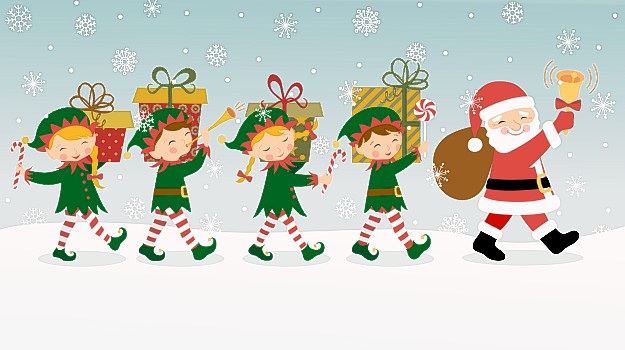
MYTH: St. Nick got along just fine without elves for over 1,000 years.
TRUTH: While the Christmas elf was briefly mentioned in some early American literature, they weren’t truly introduced into folklore until the mid-1800s and beyond. Louisa May Alcott (author of “Little Women”) was the first to introduce the concept in writing with her 1850s book, Christmas Elves, but that story was never published. The world, and Santa, had to wait until the 1873 Christmas issue of a magazine called, Godey’s Lady’s Book, which featured a cover with Santa and “elves” among toys.
The idea for Christmas elves came from European depictions of Santa which had been around for centuries and had helpers like the Dutch "Zwarte Piet." That said, Zwarte Piet was originally a slave in the Dutch narrative; and with the character customarily wearing black-face costumes, it seems the American Christmas elf was probably a huge improvement.
SOURCES:
________, "Traditions & Customs," https://www.whychristmas.com/
Mcmanus, M.R., “10 Myths About Christmas,” https://people.howstuffworks.com/culture-traditions/holidays-christmas/10-christmas-myths11.ht;
Huckabee, T., “4 Christmas Myths We’ve All Totally Bought (And The Truth Behind Them," https://relevantmagazine.com/article/4-christmas-myths-weve-all-totally-bought/;
Van Luling, T., “Everything You Know About Christmas Is Wrong," https://www.huffingtonpost.com/2013/12/09/christmas-history_n_4378951.html;
Rothschild, M., “The Biggest Christmas Myths and Legends, Debunked," https://www.ranker.com/list/christmas-myths/mike-rothschild
Legends & Myths from Around the World

.jpg)